
LED Dimming Technologies Compared: 0-10V vs DALI vs DMX vs Bluetooth Mesh for Commercial Applications
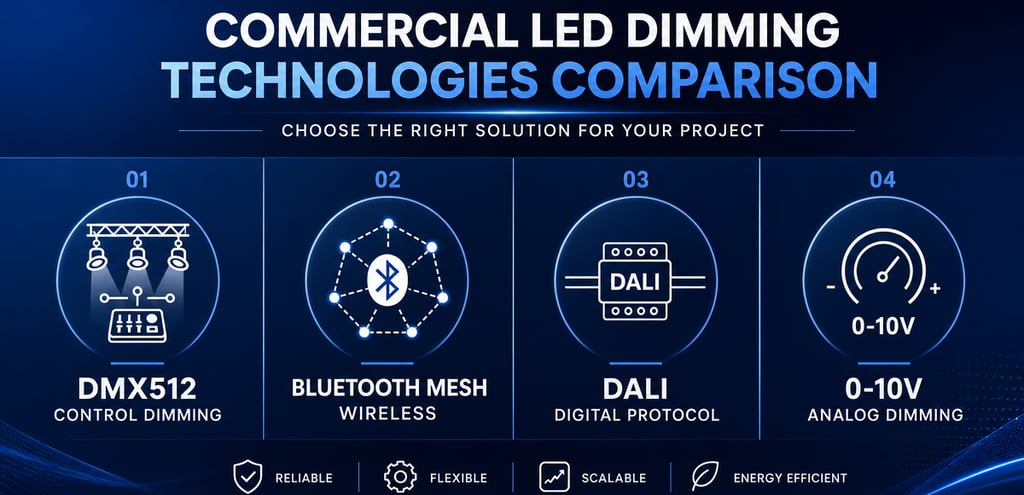
Comprehensive comparison of four major dimming protocols: 0-10V, DALI, DMX512, and Bluetooth Mesh
Daniel
5/5/20268 min read
Understanding the Critical Role of Dimming Control in Modern Commercial Lighting
In commercial environments, lighting control extends far beyond simple on/off switching. Effective dimming systems directly impact energy consumption, occupant comfort, maintenance costs, and compliance with increasingly stringent energy codes. For B2B buyers specifying lighting for offices, retail spaces, hospitality venues, and industrial facilities, selecting the appropriate dimming protocol represents a decision that affects project costs, system integration complexity, and long-term operational efficiency.
The global smart lighting market, valued at USD 16.3 billion in 2025 and projected to reach USD 84.6 billion by 2035, reflects growing demand for sophisticated lighting control across commercial sectors. Industry analysis indicates that approximately 60% of smart lighting systems now integrate IoT modules supporting multiple control protocols, yet protocol fragmentation remains a significant challenge—over 20 different protocols compete for market adoption globally.
This article provides a comprehensive technical comparison of four dominant dimming technologies: 0-10V analog, DALI (Digital Addressable Lighting Interface), DMX512, and Bluetooth Mesh. Each protocol offers distinct advantages for specific applications, and understanding these differences enables informed procurement decisions for commercial lighting projects.
0-10V Analog Dimming: The Industry Standard for Simplicity
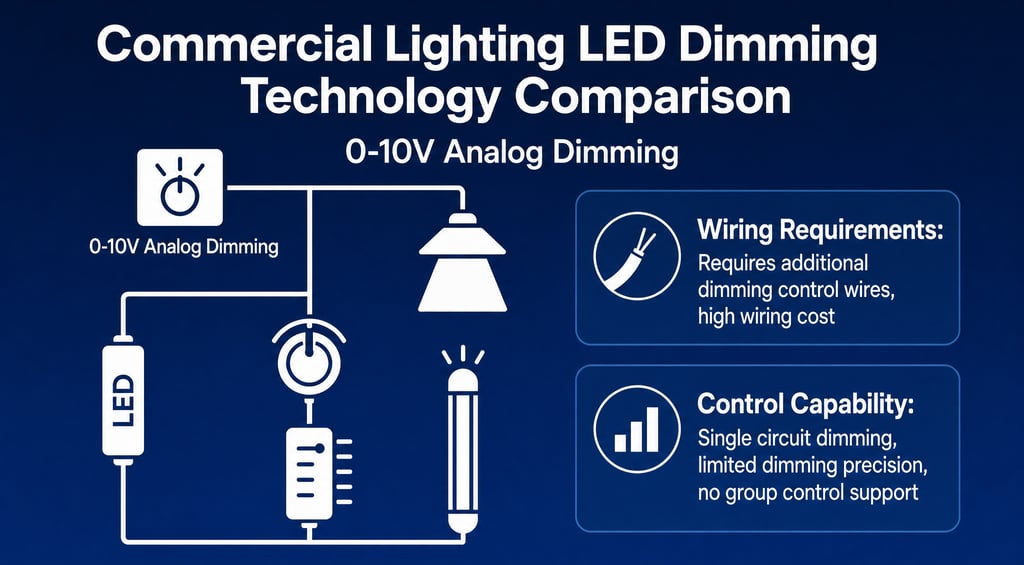
0-10V dimming represents the most straightforward and widely adopted analog control method in commercial lighting. Introduced in the 1980s, this protocol uses a variable voltage signal (0V representing minimum brightness, 10V representing full output) to control LED driver dimming levels.
Technical Specifications
Signal Type: DC voltage, 0-10V range
Dimming Range: Typically 1-100% (varies by driver manufacturer)
Wire Requirements: 2 conductors per dimming zone (power + control)
Maximum Distance: Approximately 30 meters without signal amplification
Compatibility: Universal among LED drivers from major manufacturers
Advantages for Commercial Procurement
The primary appeal of 0-10V lies in its simplicity and cost-effectiveness. Systems require minimal configuration, and compatibility between manufacturers is virtually guaranteed due to standardized signal levels. For budget-conscious projects where complex zoning is unnecessary, 0-10V provides reliable dimming performance at the lowest system cost.
Installation labor costs remain significantly lower than digital alternatives, and troubleshooting requires only basic multimeter measurements. Commercial LED fixtures with integrated 0-10V drivers typically add 5-15% to fixture cost compared to non-dimmable equivalents—among the smallest price premiums in lighting control.
Limitations and Application Constraints
However, 0-10V presents notable limitations for modern commercial applications. The protocol supports only one-way communication: the driver receives dimming instructions but cannot report status, faults, or energy consumption data. This restricts integration with building management systems (BMS) and prevents advanced features like daylight harvesting response or occupancy-based scheduling without additional sensor infrastructure.
Signal degradation over extended cable runs (beyond 30 meters) introduces noticeable dimming inconsistencies across large installations. Additionally, the 0V state may not achieve true "off" conditions on some drivers—fixtures may emit 1-5% minimum light, complicating blackout scenarios in hospitality or presentation environments.
Best suited for: Simple office retrofits, small retail spaces, budget-constrained projects, applications requiring basic daylight harvesting with single-zone photocell sensors.
DALI: The Digital Standard for Building Integration
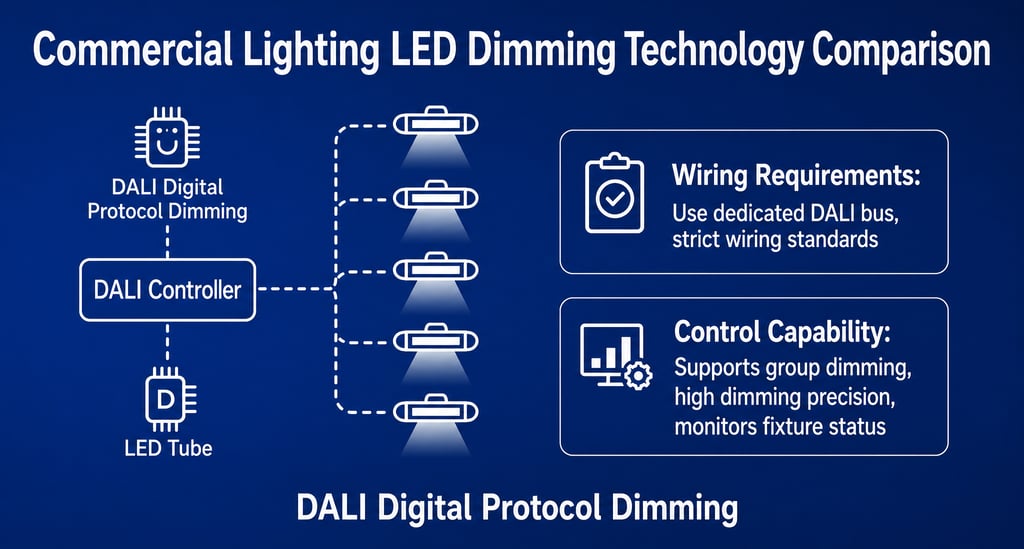
DALI (Digital Addressable Lighting Interface) emerged as an international standard (IEC 62386) specifically designed for intelligent building lighting control. Unlike analog 0-10V, DALI enables bidirectional communication, allowing each fixture to report its status, power consumption, and fault conditions to the control system.
Technical Specifications
Protocol Type: Digital, bus-based communication
Bus Capacity: Up to 64 devices per DALI line (expandable to 16,000 with gateways)
Cable Type: Standard mains voltage cable (no shielding required)
Maximum Distance: 300 meters total bus length (longer with repeaters)
Features: Individual addressing, group control, scene recall, fading time configuration
Advantages for Commercial Procurement
DALI's digital architecture delivers substantial advantages for integrated building systems. Each luminaire receives a unique address, enabling precise individual control without dedicated wiring for each fixture. This reduces cable infrastructure costs in large installations while providing granular control capabilities.
The bidirectional communication capability transforms lighting systems into data sources. Facility managers can monitor real-time energy consumption per fixture, receive automatic failure alerts, and optimize lighting schedules based on actual usage patterns. Industry data suggests that DALI-integrated systems reduce lighting energy consumption by 25-40% compared to manual switching through intelligent scheduling and daylight harvesting.
DALI-2 certification, introduced in 2020, expanded protocol capabilities and standardized control device interoperability across manufacturers. This certification ensures that DALI sensors, switches, and gateways from different vendors communicate reliably—a critical consideration for projects specifying products from multiple suppliers.
Considerations and Cost Implications
DALI implementation requires more sophisticated control hardware and programming expertise than 0-10V systems. Control gateways, programming software, and commissioning services increase upfront system costs. LED drivers with DALI interfaces typically add 15-25% to fixture pricing compared to standard drivers.
However, lifecycle cost analysis often favors DALI for medium-to-large commercial projects. The ability to modify lighting scenes without rewiring, combined with reduced maintenance costs through proactive fault detection, frequently offsets higher initial investment within 3-5 years.
Best suited for: Medium-to-large office buildings, healthcare facilities, educational institutions, commercial complexes requiring multi-zone control, projects targeting building automation integration and energy reporting
DMX512: High-Performance Control for Dynamic Applications
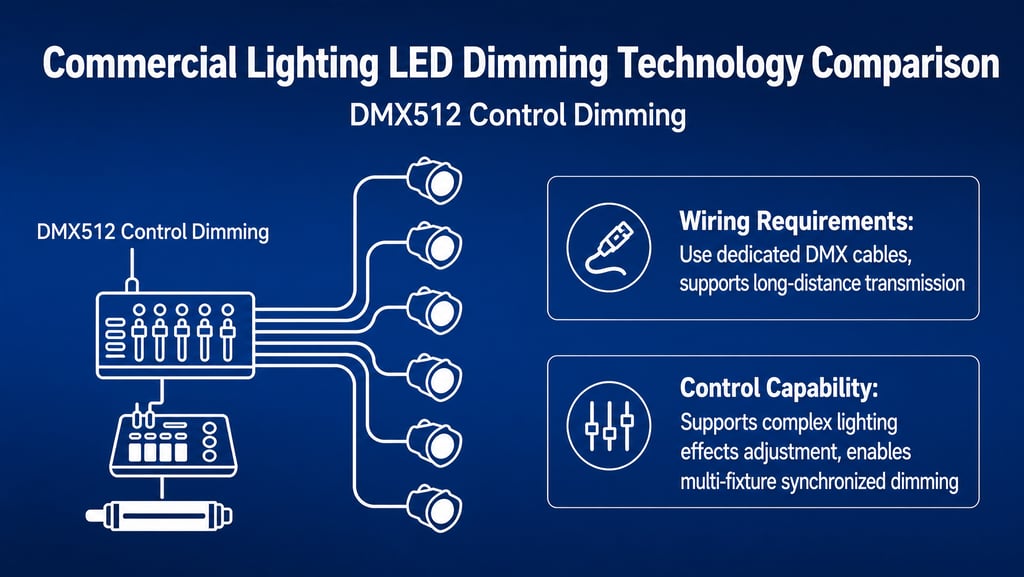
DMX512 (Digital Multiplex with 512 pieces of information) originated in theatrical lighting but has expanded significantly into architectural and entertainment lighting applications. The protocol controls up to 512 addresses per universe, with each address representing a discrete control channel.
Technical Specifications
Protocol Type: Digital, serial communication
Addresses per Universe: 512 DMX channels
Refresh Rate: 44 Hz minimum (250 kbaud)
Cable Type: DMX512-approved shielded twisted pair (5-pin XLR typically)
Maximum Distance: 300 meters without repeaters
Features: High-speed control, color mixing, strobe effects, complex show programming
Advantages for Commercial Procurement
DMX excels in applications requiring rapid, precise control of multiple lighting parameters. Each DMX channel can independently control intensity, color (RGB/RGBW), color temperature, or fixture positioning. For dynamic lighting installations—architectural facades, retail displays, hospitality lobbies—DMX enables sophisticated light shows and synchronized effects impossible with simpler protocols.
The protocol's high refresh rate (44 Hz minimum) ensures smooth dimming transitions without visible stepping or flicker, critical for broadcast environments and photography studios. DMX controllers and consoles are widely available from numerous manufacturers, and programming experience transfers across equipment brands.
Limitations in Static Commercial Applications
DMX was designed for one-way communication, meaning fixtures cannot report status back to the controller. This prevents integration with BMS platforms for energy monitoring or predictive maintenance—limitations that reduce DMX's suitability for projects requiring comprehensive building analytics.
Additionally, DMX cable infrastructure differs from standard building wiring, requiring specialized cable runs and connectors. While DMX itself is free to implement, achieving reliable performance requires quality cable, proper terminations, and careful system architecture. For static white lighting without dynamic effects, DMX often represents unnecessary complexity and cost.
Best suited for: Theaters and performing arts venues, entertainment complexes, retail environments with dynamic displays, architectural color-changing installations, broadcast and photography studios.
Bluetooth Mesh: Wireless Flexibility for Retrofit and Scalable Projects
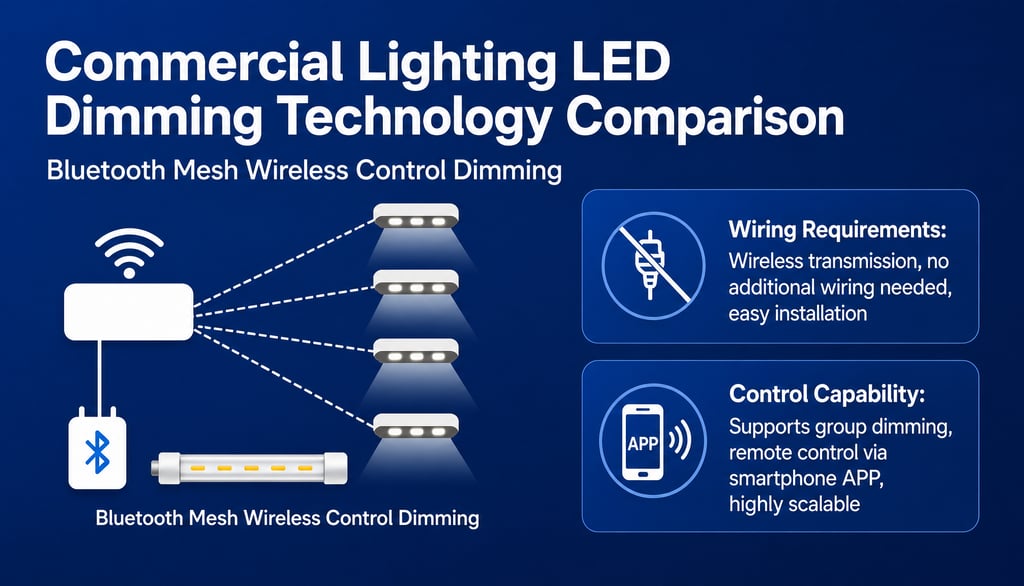
Bluetooth Mesh represents the newest entrant in commercial lighting control, leveraging the Bluetooth Low Energy (BLE) protocol's mesh networking capabilities to enable large-scale, wireless lighting control without centralized controllers or extensive wiring.
Technical Specifications
Protocol Type: Wireless mesh networking (Bluetooth 5.0+)
Network Capacity: Up to 32,000 devices per mesh network
Communication Range: 100+ meters node-to-node (unlimited via mesh relay)
Power Requirements: Extremely low energy consumption
Features: Self-healing mesh topology, over-the-air firmware updates, native smartphone commissioning
Advantages for Commercial Procurement
Bluetooth Mesh eliminates the most significant barrier to lighting control upgrades: wiring infrastructure. For retrofit projects in occupied buildings, wireless control enables lighting modernization without disruption to tenants or business operations. Installation costs frequently reduce by 40-60% compared to equivalent wired control systems.
The protocol's mesh architecture provides exceptional reliability. Data packets traverse multiple paths between devices—if one node fails, messages automatically route through alternative paths. This self-healing characteristic eliminates single points of failure that plague wired bus systems.
Smartphone-based commissioning through manufacturer apps simplifies system configuration. Facility managers can adjust zones, create scenes, and monitor energy consumption without specialized software or programming expertise. This accessibility accelerates project commissioning and reduces ongoing operational costs.
Emerging Standard Considerations
Bluetooth Mesh operates as a relatively mature but still evolving standard. While the core specification has stabilized, application layer implementations vary between manufacturers. Unlike DALI-2's certified interoperability, Bluetooth Mesh devices from different vendors may require vendor-specific apps or gateways for full functionality.
Security considerations warrant attention. While Bluetooth Mesh implements robust encryption and authentication mechanisms, network security configuration requires proper expertise. Additionally, coexistence with other 2.4 GHz wireless devices (Wi-Fi routers, wireless keyboards) may require careful channel planning in dense deployments.
Best suited for: Retrofit projects in occupied buildings, historic preservation where wiring is impractical, multi-tenant facilities requiring independent tenant control, distributed outdoor installations, projects prioritizing installation speed and minimal disruption.
Making the Right Protocol Selection
Selecting the appropriate dimming protocol requires balancing multiple project-specific factors:
Project Scale and Complexity: Small projects (under 20 fixtures, single zone) rarely justify DALI's complexity and cost—0-10V provides adequate functionality. Medium projects (20-500 fixtures, multiple zones) typically benefit from DALI's flexibility and monitoring capabilities. Large-scale deployments (500+ fixtures) may combine protocols: DALI for base building lighting, DMX for feature lighting, and Bluetooth Mesh for tenant spaces.
Building Integration Requirements: Projects targeting green building certifications (LEED, BREEAM) requiring energy reporting and optimization benefit substantially from DALI's monitoring capabilities. ASHRAE 90.1 compliance often demands automatic daylight harvesting controls and occupancy-based controls that DALI implements efficiently.
Retrofit vs. New Construction: New construction projects benefit from DALI's comprehensive capabilities and standardized wiring. Retrofit projects in occupied buildings frequently favor Bluetooth Mesh for minimal disruption, while unoccupied buildings may justify DALI installation if extensive rewiring is acceptable.
Budget Constraints: Total cost of ownership analysis typically favors more sophisticated protocols for projects with 3+ year operational horizons, but upfront budget limitations may necessitate simpler solutions.
Conclusion: Strategic Protocol Selection for Commercial Lighting Success
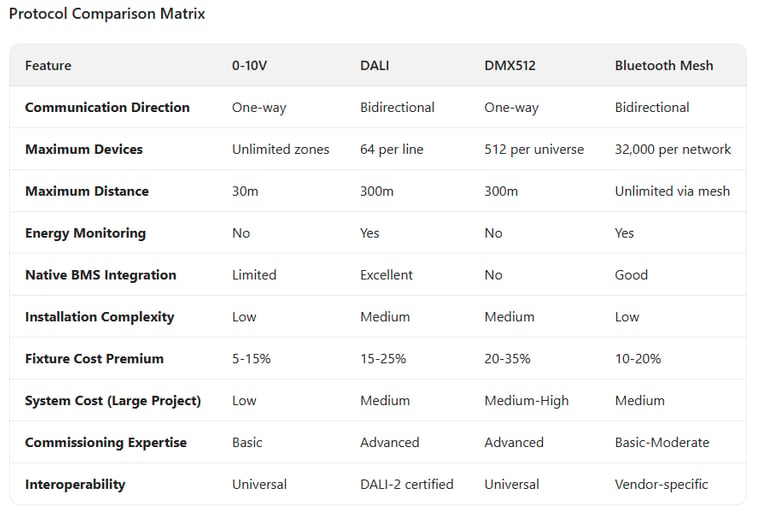
The comparison between 0-10V, DALI, DMX512, and Bluetooth Mesh reveals no universally superior protocol—each excels in specific application contexts. For most general commercial applications, DALI offers the most comprehensive feature set and best long-term value for projects requiring building integration, energy monitoring, and scalable control. Projects with unique requirements—tight budget constraints, retrofit challenges, or dynamic color-changing effects—may find alternative protocols more appropriate.
Professional lighting procurement teams should evaluate protocol selection early in project planning, as this decision affects fixture specifications, control system design, wiring infrastructure, and commissioning requirements. Engaging lighting control specialists during design phases often identifies optimization opportunities that reduce total system cost while enhancing functional capabilities.
For assistance selecting the optimal dimming solution for your specific commercial application, or to explore our range of DALI, 0-10V, and wireless-controllable LED fixtures, contact our technical sales team.
Frequently Asked Questions
Q: Can I mix different dimming protocols in a single project?
A: Yes, gateway devices enable protocol translation between systems. However, mixed-protocol systems increase complexity and should be designed carefully to ensure reliable operation.
Q: Which dimming protocol offers the best energy savings?
A: Protocol selection less affects energy savings than system design and sensor integration. Properly configured DALI or Bluetooth Mesh systems typically achieve 25-40% energy reductions through scheduling, daylight harvesting, and occupancy controls.
Q: How long does DALI commissioning take compared to 0-10V?
A: DALI commissioning typically requires 15-30 minutes per luminaire for comprehensive configuration, compared to minutes for 0-10V. However, DALI programming is a one-time investment; subsequent modifications require only software adjustments, not rewiring.
Q: Is Bluetooth Mesh suitable for mission-critical applications like healthcare?
A: Bluetooth Mesh can meet healthcare requirements when properly designed with redundant communication paths and appropriate security configurations. However, projects with stringent reliability requirements may prefer wired protocols like DALI.
This article is part of our technical resources series for professional lighting specifiers and commercial project managers.
SmartLuce
Smart OEM/ODM Lighting Solutions, Built for You
Smartluce
Quality
Email :info@smart-luce.com
Phone: +18922821140
© 2025. All rights reserved.
a brand belong to
shenzhen yobeno tech ltd
Address:Room 203A13, Block A, Fantasia Meinian Plaza, No. 1177 Nanhai Avenue, Yanshan Community, Zhaoshang Sub-district, Nanshan District, Shenzhen, China