
Comparing LED Dimming Technologies: 0-10V, DALI, DMX, and Bluetooth Mesh for Commercial Applications
LIGHT DIMMING
Daniel
5/4/20267 min read
Introduction to LED Dimming Technologies
In contemporary commercial spaces, the use of LED lighting has become increasingly prevalent, owing to its energy efficiency and flexibility. A critical component of LED systems is the incorporation of dimming technologies. These technologies allow for the adjustment of light intensity, which not only contributes to achieving desired lighting aesthetics but also plays a significant role in energy conservation.
Dimming is essential in various environments, such as offices, retail stores, and hospitality settings, as it enables control over ambiance and comfort. Moreover, effective dimming can lead to substantial energy savings, lower operational costs, and increased longevity of lighting systems. As businesses become more environmentally conscious, the demand for efficient and programmable lighting solutions continues to grow.
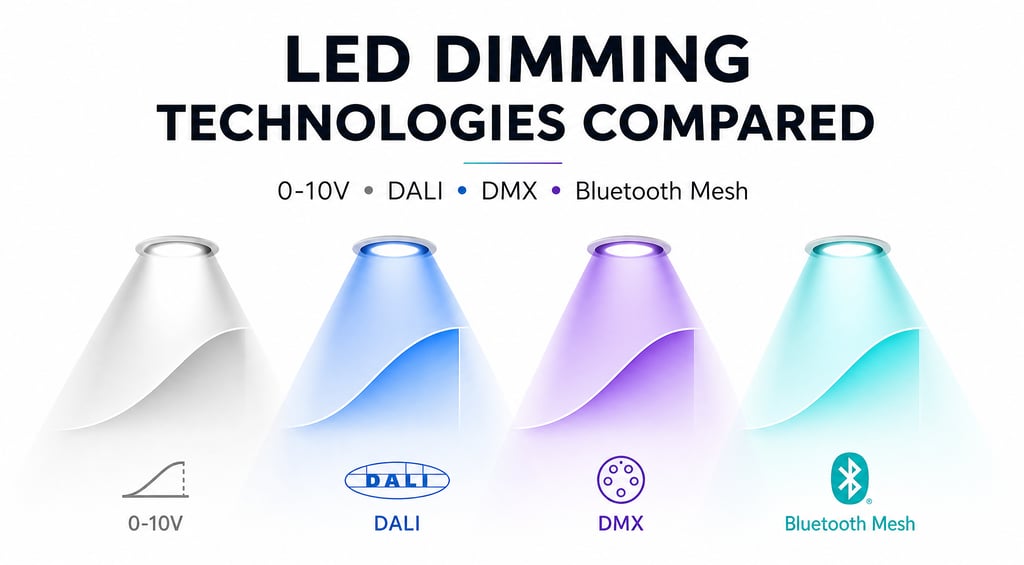
There are several dimming protocols, each tailored to meet specific lighting requirements. The 0-10V dimming system is one of the oldest and most widely adopted methods, allowing for linear dimming by adjusting voltage. DALI, or Digital Addressable Lighting Interface, offers more sophisticated control, enabling individual fixture addressing and sophisticated automation. In contrast, DMX is primarily used in entertainment and theater environments, where dynamic lighting effects are required. Lastly, Bluetooth Mesh technology presents a modern wireless solution, integrating seamlessly with smart building systems and providing user-friendly control through mobile devices.
This overview of LED dimming technologies illustrates their diversity and application in commercial contexts. By understanding these protocols, lighting designers and facility managers can make informed decisions to enhance both functionality and ambiance in their spaces. Each technology offers unique benefits, catering to specific needs and preferences, showcasing the importance of LED dimming in contemporary lighting strategies.
Overview of 0-10V Dimming
0-10V dimming technology is a widely adopted method for controlling the intensity of LED lighting in various commercial environments. This system operates based on a simple yet effective principle whereby the voltage sent to the lighting fixture determines its brightness. Specifically, a control signal that ranges from 0 volts (complete dimming) to 10 volts (full brightness) is transmitted. As a result, the architecture of this system is remarkably straightforward, making it suitable for a broad array of settings, from office spaces to retail shops.
The primary components involved in a 0-10V dimming setup include the dimmable LED drivers and the control sources, which can range from wall-mounted dimmer switches to advanced control systems. These drivers translate the 0-10V signal into corresponding changes in light output, thereby facilitating seamless dimming operations. Additionally, the simplicity of the system allows for easy installation and integration into existing lighting frameworks.
Among the notable benefits of 0-10V dimming technology is its cost-effectiveness, particularly in commercial applications where large-scale lighting solutions are required. The system supports energy savings by allowing users to adjust light levels based on occupancy and times of day, thus optimizing energy consumption. Furthermore, it is compatible with various LED fixtures, which enhances its versatility across differing project needs.
However, the technology does have its limitations. One of the primary concerns is the potential for compatibility issues with certain LED drivers and fixtures, which can lead to flickering or inconsistent light levels. Furthermore, the control system's analog nature may not support as sophisticated capabilities as some digital alternatives, such as DALI or DMX. Consequently, while 0-10V dimming remains a practical choice for many applications, careful planning and selection of compatible components are critical to ensure optimal performance.
Understanding DALI Dimming
The Digital Addressable Lighting Interface (DALI) is a highly regarded standard in lighting control, primarily utilized in commercial applications. Unlike traditional analog dimming methods, such as 0-10V systems, DALI operates on digital signaling, offering enhanced functionality and precision in managing lighting systems. This digital approach allows for individual addressing of luminaires, which facilitates more intricate control schemes and tailored lighting experiences.
One of the significant advantages of DALI dimming technology is its programmability. Users can configure specific parameters, such as fade rates and scene settings, allowing for dynamic adjustments that cater to various lighting needs. With DALI, lighting can be easily customized based on occupancy, time of day, or specific tasks, thus improving energy efficiency and user satisfaction.
Furthermore, DALI offers sophisticated capabilities such as feedback mechanisms. This means that users can receive real-time data regarding the status and performance of lighting fixtures. Such insights can prove invaluable for maintenance, enabling timely interventions and prolonging the life of the lighting infrastructure.
However, the complexity of DALI systems can be a double-edged sword. Its installation requires a deeper understanding of digital protocols compared to simpler systems like 0-10V, which involve basic voltage control. This complexity can translate to higher installation costs and necessitate skilled technicians for setup and maintenance. Conversely, the benefits of programmable, addressable lighting often justify these initial challenges, particularly in environments where precise lighting control is paramount.
In essence, DALI dimming technology represents a cutting-edge solution for commercial lighting applications, balancing advanced capabilities with the need for more intricate installation procedures. The investment in DALI systems can lead to long-term advantages, making it a compelling choice for organizations looking to enhance their lighting management strategies.
Exploring DMX Dimming Technology
DMX (Digital Multiplex) dimming technology is a widely recognized protocol used for controlling lighting in theatrical, architectural, and artistic environments. This technology allows multiple lighting fixtures to be controlled from a single controller, facilitating dynamic and intricate lighting designs. The inherent advantage of DMX is its ability to transmit digital signals over long distances, making it ideal for complex setups often seen in performance spaces.
At its core, DMX operates on a communication protocol that typically uses a master-slave architecture. The controller acts as the master, sending out commands to the slave devices, which can include dimmers and fixtures. This allows for precise control over multiple channels, enabling users to adjust brightness, color, and even moving light positions in real-time. For instance, a DMX network can have up to 512 channels, each capable of controlling a separate fixture or light attribute, making it a robust solution for dynamic lighting effects.
Moreover, DMX dimming technology is well-suited for environments that require rapid changes in lighting, such as theatres and concert venues. It allows stage operators to create complex scenes by quickly transitioning between settings, which is crucial during live performances. The protocol's ability to support multiple universes or networks further enhances its versatility, catering to the needs of expansive and elaborate installations. Additionally, the integration of DMX with software control systems has expanded its applications, providing even further flexibility in design and execution.
Overall, DMX dimming technology stands out due to its sophisticated communication protocols, real-time control features, and strong applicability in dynamic lighting environments. Understanding its capabilities is essential for anyone involved in the lighting industry, particularly for those focusing on theatrical presentations and art installations.
Bluetooth Mesh Dimming Technology
Bluetooth Mesh technology represents a significant advancement in the realm of wireless lighting control, particularly beneficial for commercial applications. This innovative solution utilizes a decentralized network that allows various devices to communicate with one another, providing flexibility and scalability in managing lighting systems.
One of the key advantages of Bluetooth Mesh is its ease of installation. Unlike traditional wired systems which can be cumbersome and time-consuming to set up, Bluetooth Mesh systems often require minimal infrastructure changes. This reduces installation costs and minimizes disruptions to existing operations, making it an attractive option for businesses aiming to upgrade their lighting systems without extensive renovations.
In addition to straightforward installation, Bluetooth Mesh technology is known for its user-friendly interfaces. Many systems come with intuitive applications that allow users to control their lighting easily from mobile devices or tablets. This accessibility enables users to adjust light levels, create schedules, and manage different zones of lighting with just a few taps on their screens, enhancing the overall user experience.
Scalability is another defining feature of Bluetooth Mesh. This technology allows for the seamless addition of new fixtures or devices to the existing network. As businesses grow and their lighting needs evolve, they can expand their systems without the need for complex rewiring or reconfiguration. This dynamic capability makes Bluetooth Mesh an excellent choice for commercial environments where flexibility is paramount.
Overall, Bluetooth Mesh dimming technology stands out for its ease of use, efficient installation process, and adaptable nature, all of which contribute to its growing popularity in commercial lighting applications.
Comparative Analysis of Dimming Technologies
When evaluating LED dimming technologies such as 0-10V, DALI, DMX, and Bluetooth Mesh for commercial applications, it is essential to consider multiple criteria, including cost, installation complexity, control features, and applicable usage scenarios. Each technology offers unique benefits and potential drawbacks, influencing their suitability for varied commercial lighting projects.
The 0-10V dimming system is often viewed as a cost-effective option, particularly for straightforward installations. With its simple wiring needs, the 0-10V technology typically requires less initial investment and can be effective in environments where basic dimming functions suffice. However, it lacks more sophisticated control features that other technologies provide, which may limit its functionality in advanced applications.
DALI (Digital Addressable Lighting Interface) represents a significant upgrade over 0-10V, providing enhanced capabilities such as individual addressing and monitoring of fixtures. While the installation complexity rises due to more intricate wiring requirements, the robust control features and flexibility of DALI make it suitable for larger, more dynamic environments. It allows for the integration of various lighting scenarios, enhancing user experience in commercial spaces.
DMX (Digital Multiplex) is predominantly used in theatrical settings but is increasingly recognized in commercial applications. It offers extensive control options suitable for advanced lighting setups, particularly for visual displays and ambiance creation. However, DMX systems are generally more complex to install and manage, potentially leading to higher costs and specialized knowledge requirements.
Bluetooth Mesh technology is gaining traction due to its wireless capabilities and ease of integration. Ideal for retrofitting existing structures, it allows for comprehensive control without extensive rewiring. Although it offers flexibility and user-friendly applications, initial costs may be higher compared to more traditional systems.
Assessing these technologies through the lens of cost, installation complexity, control features, and specific application scenarios will provide a clearer understanding of which dimming technology is best suited for a given commercial environment.
Conclusion and Future Trends in LED Dimming
As we have explored throughout this discussion, LED dimming technologies are integral to modern commercial lighting solutions. The various methods, including 0-10V, DALI, DMX, and Bluetooth Mesh, each present unique benefits suited to specific applications and environments. Through our examination, it is clear that these technologies offer flexibility, efficiency, and enhanced user control over lighting conditions, contributing to overall energy savings and improved user experience.
Looking to the future, the evolution of LED dimming technologies is poised to intertwine closely with advancements in smart building systems. The ability to seamlessly integrate lighting controls with IoT (Internet of Things) devices will allow for more sophisticated automation and analytics capabilities. For instance, utilizing sensors to adjust lighting based on occupancy or natural light levels can not only enhance comfort but also significantly reduce energy consumption. This interaction will likely lead to a greater reliance on wireless technologies, including Bluetooth Mesh, facilitating easier communication and management of lighting networks.
Furthermore, the development of user-centric control interfaces is expected to rise, allowing occupants to customize their lighting environments through mobile applications and other smart interfaces. This shift towards personalization, coupled with environmental considerations, indicates a growing trend towards adopting sustainable practices in building management systems. As LED dimming technologies advance, the implications for creating efficient, responsive, and adaptive lighting systems will continue to evolve, aligning with the needs of modern commercial spaces. Therefore, stakeholders in the lighting industry must keep abreast of these trends to fully leverage the potential of LED dimming systems.
SmartLuce
Smart OEM/ODM Lighting Solutions, Built for You
Smartluce
Quality
Email :info@smart-luce.com
Phone: +18922821140
© 2025. All rights reserved.
a brand belong to
shenzhen yobeno tech ltd
Address:Room 203A13, Block A, Fantasia Meinian Plaza, No. 1177 Nanhai Avenue, Yanshan Community, Zhaoshang Sub-district, Nanshan District, Shenzhen, China